Ausstellung »URBS ANIMALIS – Die Stadt als Lebensraum von Tier und Mensch«
Exhibition “URBS ANIMALIS – The City as a Habitat for Animals and Humans”
–> Ausstellungs-Webseite / Exhibition website
Künstlerinformation / Artist information (translation below)
www.marcuscoates.co.uk
www.instagram.com/marcus_coates_
Oben: »Mönchsgrasmücke II«.
Unten: »Singdrossel«.
Video stills from “Dawn Chorus”, 2007.
Top: “Blackcap II.” Bottom: “Song thrush.”
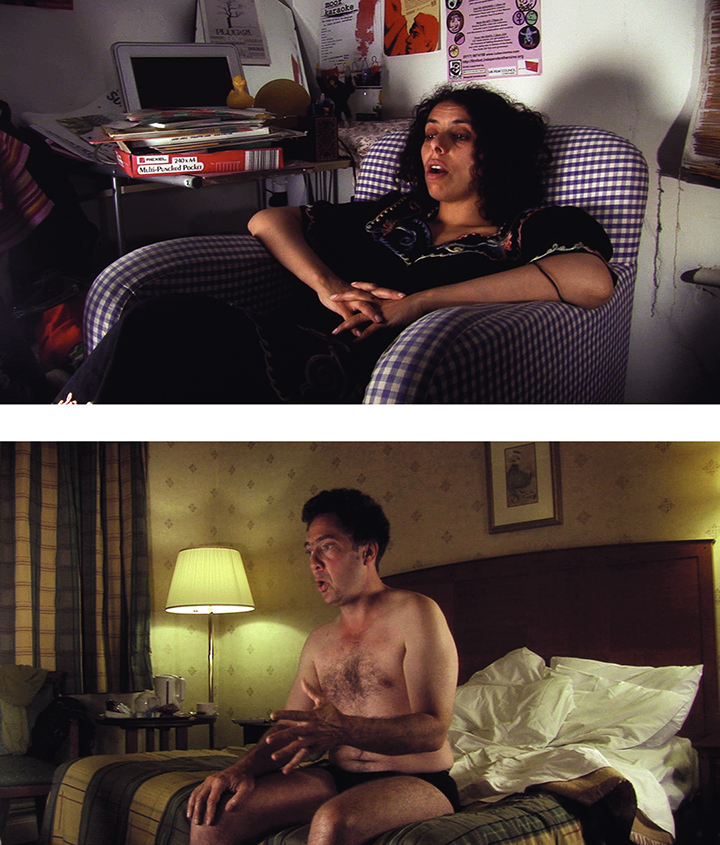
14- oder 7-Kanal-Videoinstallation, HD 1080 ? 1920 16:9, 18-minütige Schleife.
Feldaufnahmen von Geoff Sample. Gefilmt in Bristol, Vereinigtes Königreich. Kamera: Louie Blystad-Collins.
Ton: Paul Baker und Mary Milton.
Sänger:innen: Paul Baker, Joe Bradley, Barrington Chambers, Sue Coates, Pearl Conway, Ed Guilbert, Norma Head, James Murden, Ben Owen, Phoebe Partridge, Piers Partridge, Meena Reetooraz-Yeomans, Rasha Shaheen, Yoshino Shigihara, Alfie Vergano, Rina Vergano, Nick, David Rothenberg.
Wissenschaftlicher Berater: Peter McGregor. Video-Postproduktion: Picture This. In Auftrag gegeben und produziert von Picture This. Gefördert vom Wellcome Trust.
Die Videoinstallation nutzt menschliche Stimmen, um das natürliche Phänomen eines Vogelgesangschors im Morgengrauen während des Frühlings nachzubilden. Jeder der vierzehn Bildschirme zeigt einen menschlichen Lebensraum: ein Auto, ein Büro, ein Schlafzimmer, ein Lehrerzimmer usw. Zu sehen sind Menschen, die in ihrer jeweiligen Umgebung sitzen und präzisen Vogelgesang singen.
Mit Unterstützung von Coates nahm Geoff Sample (Wildtier-Tonaufnehmer) die Gesänge einzelner Wildvögel am Rand eines kleinen Waldstücks nahe Bamburgh in Northumberland zwischen 3 Uhr morgens und 9 Uhr morgens im Mai 2005 auf. Dabei verwendeten sie bis zu vierzehn Mikrofone, um gleichzeitig möglichst viele der einzelnen Vogelgesänge aufzuzeichnen. Die Aufnahmen jedes Vogels wurden anschließend um bis zu das Zwanzigfache verlangsamt, wodurch die Tonhöhe abgesenkt und die Dauer verlängert wurde, sodass sie in den Stimmumfang des Menschen fielen und langsam genug wurden, um sie mitsingen zu können.
Sänger:innen aus verschiedenen Chören in Bristol, Vereinigtes Königreich, meldeten sich freiwillig, um diese verlangsamten Aufnahmen nachzuahmen. Sie wurden entsprechend ihres Stimmumfangs und ihrer stimmlichen Fähigkeiten ausgewählt, da sich die Vogelgesänge in ihrer Komplexität unterschieden. Manche Vogelgesänge, etwa der des Rotkehlchens, besitzen einen großen Tonumfang und unvorhersehbare Rhythmen; andere, wie der des Zilpzalps (wie der Name bereits andeutet), wiederholen zwei einfache hohe Töne, die in verlangsamter Form bislang ungehörte Töne und Dynamiken erkennen lassen. Anschließend wurden die Sänger:innen bis zu zwei Stunden lang dabei gefilmt, wie sie zu diesem verlangsamten Vogelgesang mitsangen.
Das Videomaterial wurde zusammen mit dem Ton anschließend wieder auf das ursprüngliche Tempo des Vogelgesangs beschleunigt (ungefähr zwanzigmal schneller), wodurch sich die menschliche Stimme in die eines Vogels verwandelte. Wenn die einzelnen Personen gemeinsam gesehen und gehört werden, entsprechen die zeitlichen Abstände ihrer Gesänge zueinander genau denen der Vögel an dem Morgen, an dem die Gesänge ursprünglich aufgenommen wurden..
14 or 7 channel video installation, HD 1080 ? 1920 16:9, 18 min loop.
Fieldwork recordings by Geoff Sample. Filmed in Bristol, UK. Filmed by Louie Blystad-Collins.
Sound by Paul Baker and Mary Milton.
Singers: Paul Baker, Joe Bradley, Barrington Chambers, Sue Coates, Pearl Conway, Ed Guilbert, Norma Head, James Murden, Ben Owen, Phoebe Partridge, Piers Partridge, Meena Reetooraz-Yeomans, Rasha Shaheen, Yoshino Shigihara, Alfie Vergano, Rina Vergano, Nick, David Rothenberg
Scientific Advisor: Peter McGregor. Video post-production: Picture This. Commissioned and produced by Picture This. Funded by Wellcome Trust.
The video installation uses human voices to replicate the natural phenomena of a birdsong chorus at dawn during Spring. Each of the fourteen screens feature a view of a human habitat: a car, an office, a bedroom, a school staff room etc. Individuals are seen sitting in their domains singing accurate birdsong.
Assisted by Coates, Geoff Sample (wildlife sound recordist) recorded the individual wild bird’s songs on the edge of a small woodland near Bamburgh, Northumberland, from 3 am to 9 am in May 2005. They used up to fourteen microphones to simultaneously record as many of the individual songs as they could. The recordings of each bird were then slowed down by up to 20 times, lowering the tone and lengthening the duration so that they fell in the range of the human voice and became slow enough to sing along to.
Singers from a variety of choirs in Bristol, UK, volunteered to mimic these slowed down recordings. They were selected according to their vocal range and ability as the bird songs varied in their complexity. Some birdsongs, like the robin’s, have a broad tonal range and unpredictable rhythms; others, like the chiffchaff (as the name suggests), repeat two simple high pitch notes which when slowed down, reveal previously unheard notes and dynamics. The singers were then filmed singing along to this slowed down birdsong for up to two hours.
The video footage together with the audio was then sped up to the original tempo of the birdsong (approximately 20 times faster), creating a transformation of the human voice into that of a bird. When the individuals are seen and heard as a collective, the timings of their songs, relative to each other, replicate when they were sung by birds on the morning they were originally recorded.
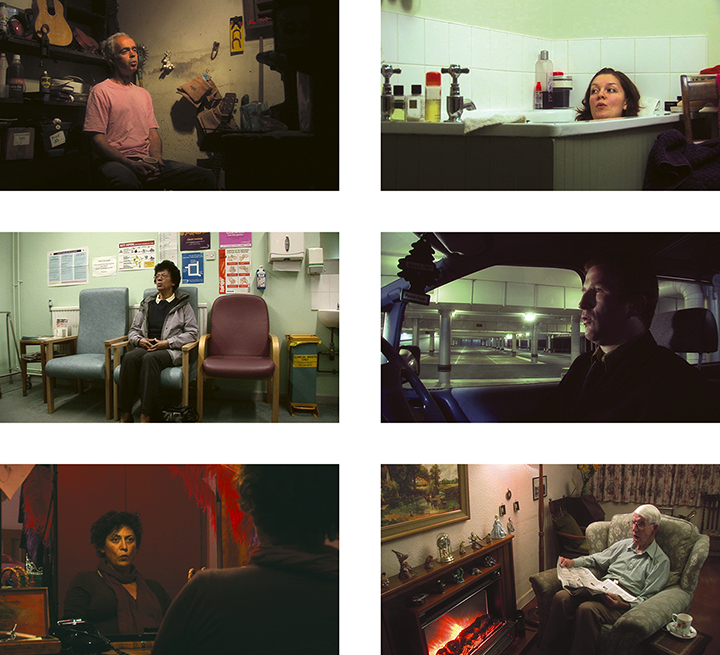
Oben von links nach rechts: »Amsel« und »Mönchsgrasmücke I«. Mitte von links nach rechts: »Buchfink« und »Schwalbe«. Unten von links nach rechts: »Heckenbraunelle« und »Fasan««
Video stills from “Dawn Chorus”, 2007.
Top from left to right: “Blackbird” and “Blackcap I.” Middle from left to right: “Chaffinch” and “Swallow”. Bottom from left to right: “Dunnock” and “Pheasant.”
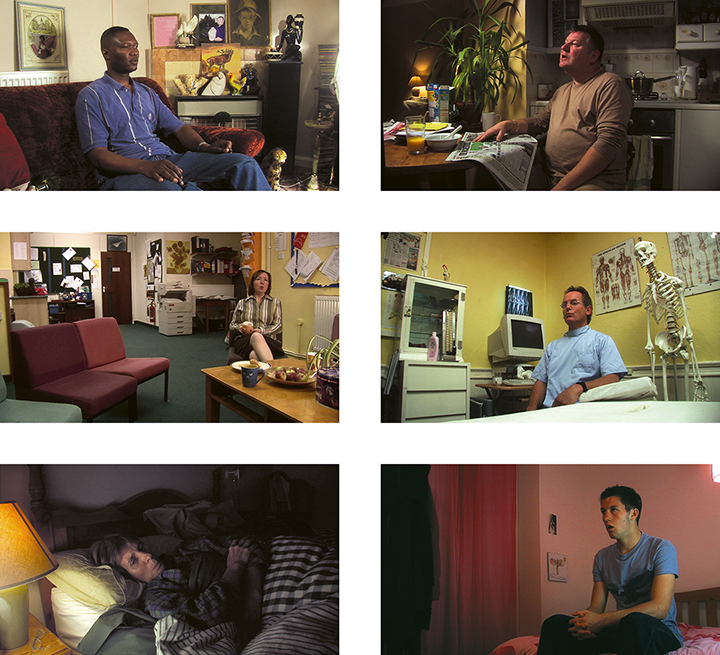
Oben von links nach rechts: »Dorngrasmücke« und »Goldammer II«. Mitte von links nach rechts: »Zilpzalp« und »Bluthänfling«. Unten von links nach rechts: »Blaumeise« und »Goldammer I«
Video stills from “Dawn Chorus”, 2007.
Top from left to right: “Whitethroat” and “Yellowhammer II.” Middle from left to right: “Chiffchaff” and “Linnet”. Bottom from left to right: “Bluetit” and “Yellowhammer I.”.
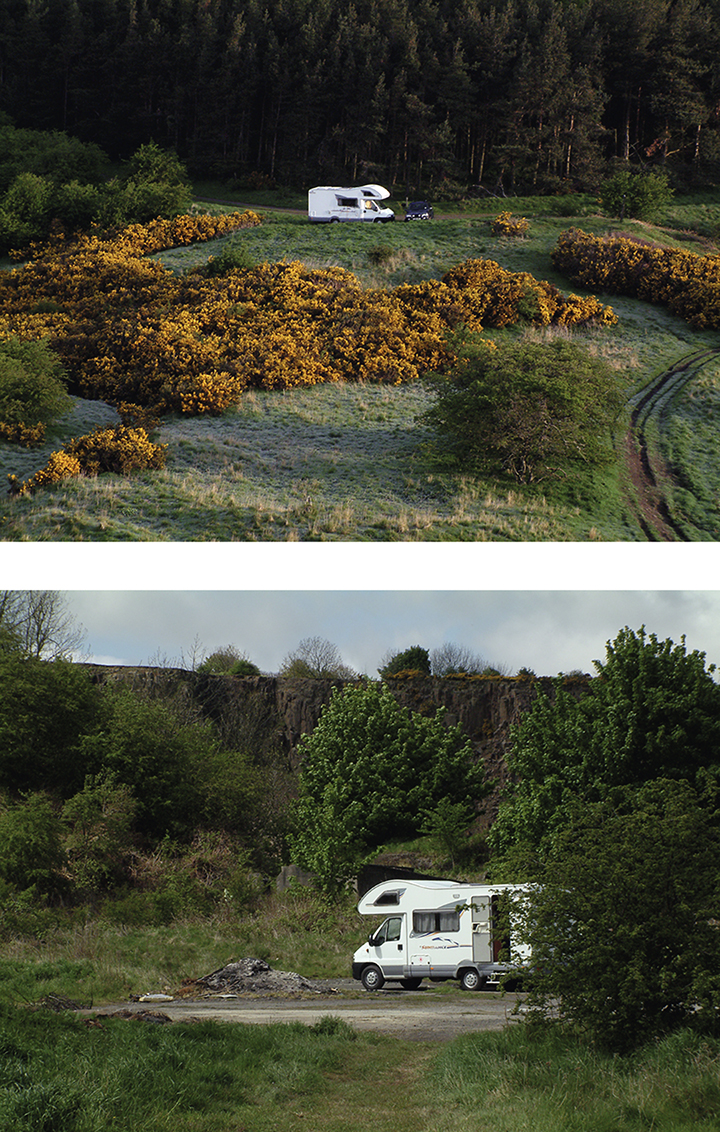
Foto: Marcus Coates & Geoff Sample.
During the field recordings in Northumberland.
Photo: Marcus Coates & Geoff Sample.
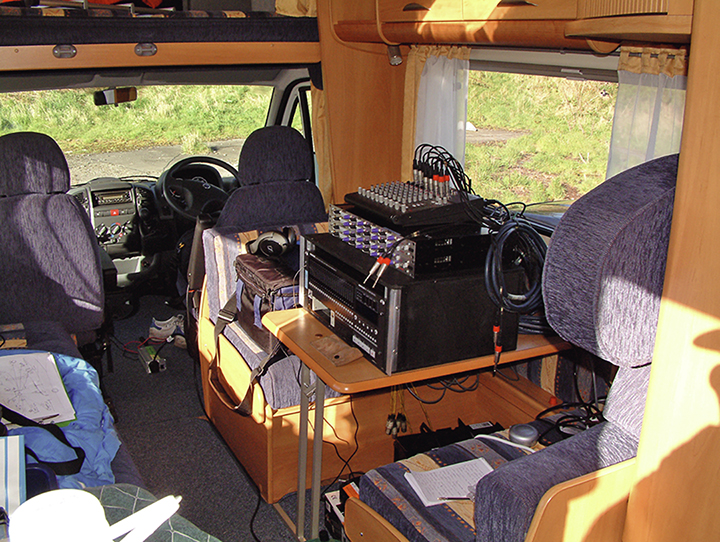
Foto: Marcus Coates & Geoff Sample.
Motorhome with digital audio recording technology.
Photo: Marcus Coates & Geoff Sample.
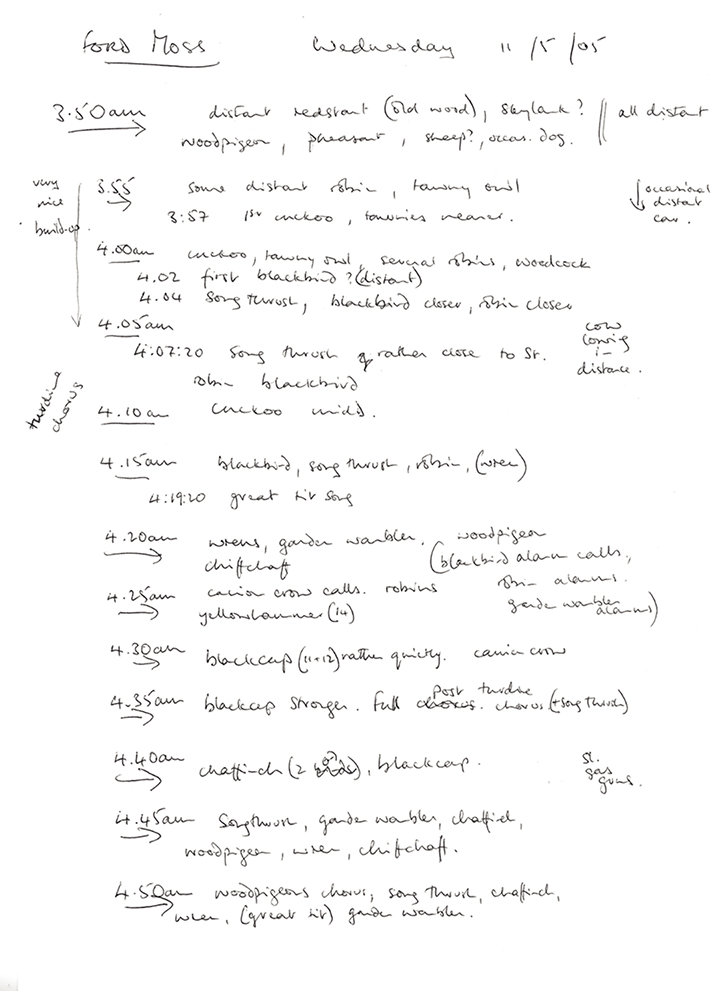
Foto: Marcus Coates & Geoff Sample.
Excerpt from the “Ford Moss Diary”.
Photo: Marcus Coates & Geoff Sample.
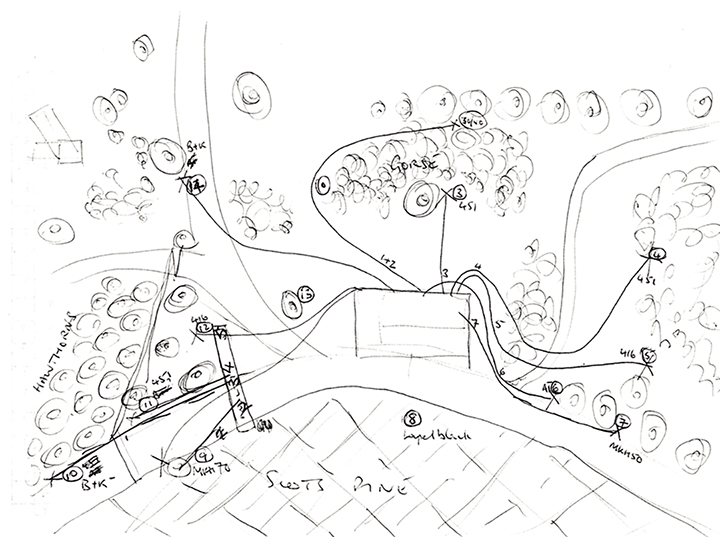
Foto: Marcus Coates & Geoff Sample.
Drawing showing microphone placement (Ford Moss).
Photo: Marcus Coates & Geoff Sample.
© Künstlerverein Walkmühle e.V.